

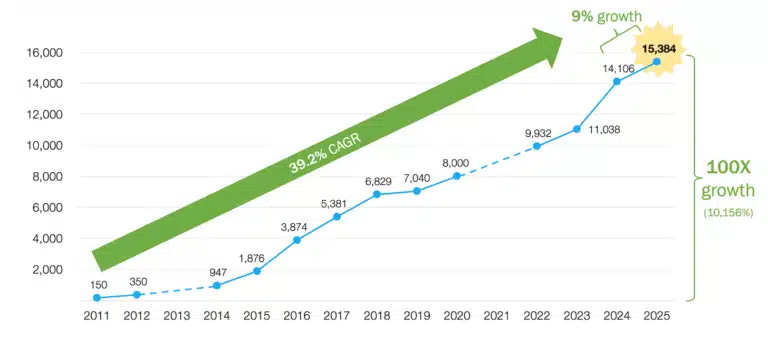
Source: Chiefmartec.com
Skip this part - if you already know why I'm doing this!
Back when I started my career in 2011, I honestly had no clue what I was signing up for. I started as a Web/CMS developer, and over time found myself working with multiple enterprise-level brands and martech stakeholders across regions. Pretty quickly, I realized it would take me multiple lifetimes to master every tool across all these categories. So instead, I shifted my focus to exploring the tech stack with a purpose- and value-driven mindset.
With an expert researcher/consultant like chatgpt/claude/grok at your disposal, I can say with confidence: technical expertise is no longer a bottleneck. Whether it’s 15k+ martech tools today or 50k AI tools in the next five years, I don’t need to fear or feel FOMO every day. Yes, AI has made my life easier — and I hope it brings you more peace than chaos. Here, I share practical ways to brave this storm and handle uncertainty, built on years of hands-on research and experience.
Start here → 15384 tools as of May 2025!
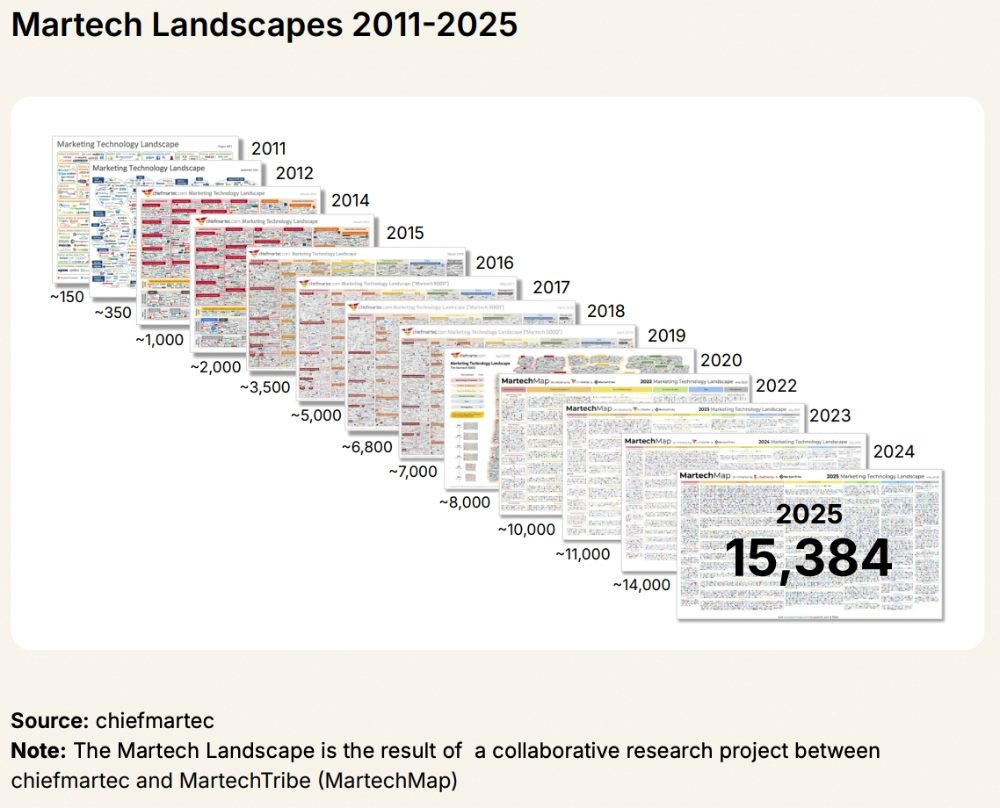
Here’s the truth: you don’t need to be an expert or need to know them all but you need to master one thing — how to ask AI the right questions so your existing stack actually works for the business.
Quick Framework (Works with any stack)
Most stacks, whether HubSpot, Adobe, Salesforce, or a Frankenstein mix, boil down to five building blocks: content, data, automation, analytics, CRM.
AI helps you operate across those blocks with three moves:
1 — Ask better questions
Use AI as an on-demand analyst. Give it your stack + goal (e.g., “improve pipeline velocity”). Ask it to flag underused features, suggest workflows, and list metrics that prove progress.
2 — Automate the connectors
Your stack’s value lives in the connections, not the logos. Use AI to map integrations or generate logic before dev hours get burned.
Example: “How do I sync lead scoring from my automation tool to CRM in real time?”
3 — Translate into business outcomes
Executives want pipeline, revenue, retention — not CTR. AI reframes Martech metrics into boardroom language instantly.
Five Practical Ways to Use AI Today
First-pass auditor — “Here’s my stack + goal. What are 5 low-effort wins?”
Gap finder — Ask AI where silos live and how to bridge them.
Prompt-driven campaigns — Replace long decks with tight prompts like: “Increase webinar regs by 30% with minimal extra budget.”
Reporting copilot — “What 3 insights should I act on now?” or “Which elements are wasting spend?”
Stack agility — “How do I do X in [tool A] vs [tool B]?” → kills FOMO.
Top 1% Prompt Example — Customer Journey Analysis
This is how pros use AI with Martech data:
Prompt:
“You are my Customer Journey Analyst. I have Adobe Analytics, GA4, and CRM opportunity data. My goal: find where prospects drop off from first touch → MQL → SQL → Closed Won.
Map top 3 customer paths.
Identify the largest drop-off + quantify lost pipeline.
Recommend 2 interventions using my existing stack.
Draft a 10-min exec summary for sales leadership.”
Sample AI output:
Drop-off: Demo request form abandonment (48%) → Lost pipeline: ~$2.3M/Q2
Fixes: (1) Simplify form with progressive profiling, (2) Trigger retargeting workflows in Marketo
Boardroom line: “We’re losing $2.3M at demo request. Here’s a 30-day plan to recover it.”
👉 That’s the difference between a reporting operator and a growth enabler.
Final Word
The Martech storm will only get louder. With AI in your pocket, you don’t need another certification or consultant.
You just need to ask sharper questions, connect the dots, and turn noise into business outcomes.
⚡ That’s the craft I’m sharing here, one post at a time.